> For the complete documentation index, see [llms.txt](https://docs.snyk.io/llms.txt). Markdown versions of documentation pages are available by appending `.md` to page URLs; this page is available as [Markdown](https://docs.snyk.io/scan-fix-and-prevent/fix/snyk-pull-or-merge-requests.md).
# Snyk Pull or Merge Requests
How Snyk pull and merge requests fix and upgrade dependencies
{% hint style="info" %}
**Snyk is rolling out a new navigation.** The steps on this page describe the classic interface. If your view looks different, visit [Navigate the Snyk Web UI](https://docs.snyk.io/navigate-the-snyk-web-ui#where-things-moved) to map these options to the new interface.
{% endhint %}
## Snyk Pull or Merge Requests
In addition to providing fix advice, Snyk enables you create automatic or manual pull requests for supported package managers and ecosystems. To create PRs automatically in implementations with Snyk Broker, your administrator must upgrade to v4.55.0 or later.
{% hint style="info" %}
For the basic steps in fixing vulnerabilities, see [Fix your vulnerabilities](/scan-fix-and-prevent/scan-with-snyk/snyk-open-source/manage-vulnerabilities/fix-your-vulnerabilities.md). To ensure your language is supported, see [Languages supported for Fix Pull Requests or Merge Requests](/scan-fix-and-prevent/scan-with-snyk/snyk-open-source/manage-vulnerabilities/troubleshoot-fixing-vulnerabilities-with-snyk-open-source.md#languages-supported-for-fix-pull-requests-or-merge-requests) and [Supported browsers](https://docs.snyk.io/getting-started-guides/getting-started#supported-browsers) pages.
{% endhint %}
{% hint style="info" %}
Administrators and account owners can manage the settings for Snyk upgrade pull requests from the Snyk Web UI at both the Organization and Project levels. You can configure whether the feature is enabled (the default) and specify the conditions under which Snyk should submit upgrade pull requests, if at all.
{% endhint %}
### Manual Fix PRs
For specific supported languages, you can create pull requests to remediate issues using the Snyk web UI. These combine Snyk fix advice with the list of remediated vulnerabilities to create a pull request that developers can review and merge into their repo's main branch.
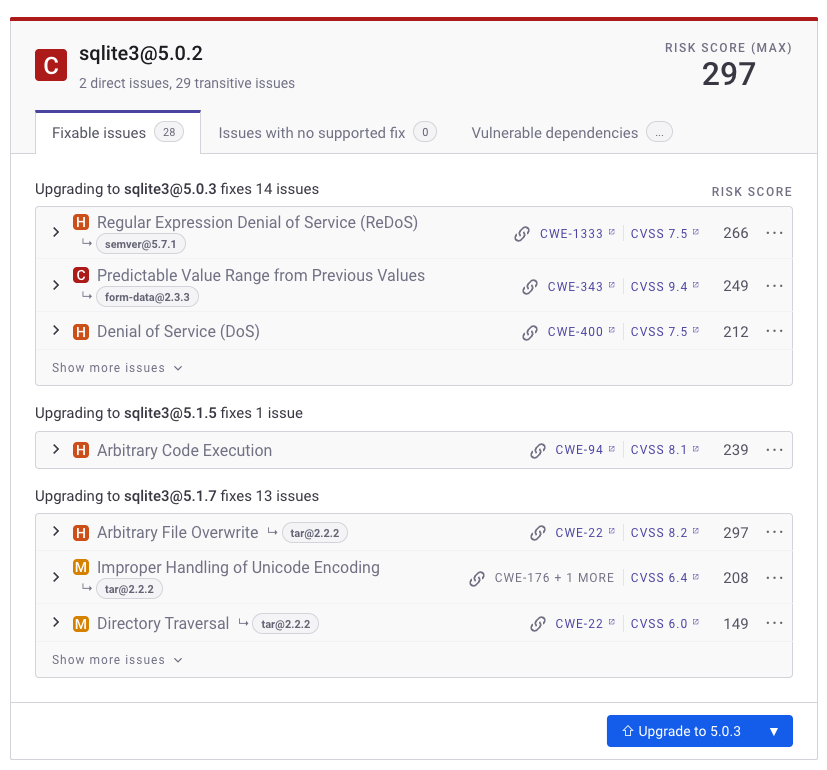
You can start the process from any supported Project's open source vulnerability view.
Vulnerability view of an issue
{% hint style="info" %}
PRs use a branch naming convention based on the issues they fix. If a PR already exists for a specific change, Snyk does not create a new one, even if you closed the original PR.
If you try to create a duplicate fix PR, Snyk displays an error. To resolve this, check if the branch already exists and reopen the pull request.
{% endhint %}
### Defining Automatic Snyk PRs
For Projects imported through an SCM integration, Snyk offers automatic pull request generation for vulnerability fixes, package upgrades, and backlog vulnerabilities. To learn more, visit:
* [Enable Automatic Fix PRs](/scan-fix-and-prevent/fix/snyk-pull-or-merge-requests/enable-automatic-fix-prs.md)
* [Enable Automatic Backlog PRs](/scan-fix-and-prevent/fix/snyk-pull-or-merge-requests/enable-automatic-backlog-prs-for-previously-known-vulnerabilities.md)
* [Enable Automatic Upgrade PRs](/scan-fix-and-prevent/fix/snyk-pull-or-merge-requests/enable-automatic-upgrade-prs-for-new-dependency-upgrades.md)
### Reviewing Snyk PRs
After Snyk submits a pull request on your behalf, you can view the pull request and all related details directly from the relevant repository.
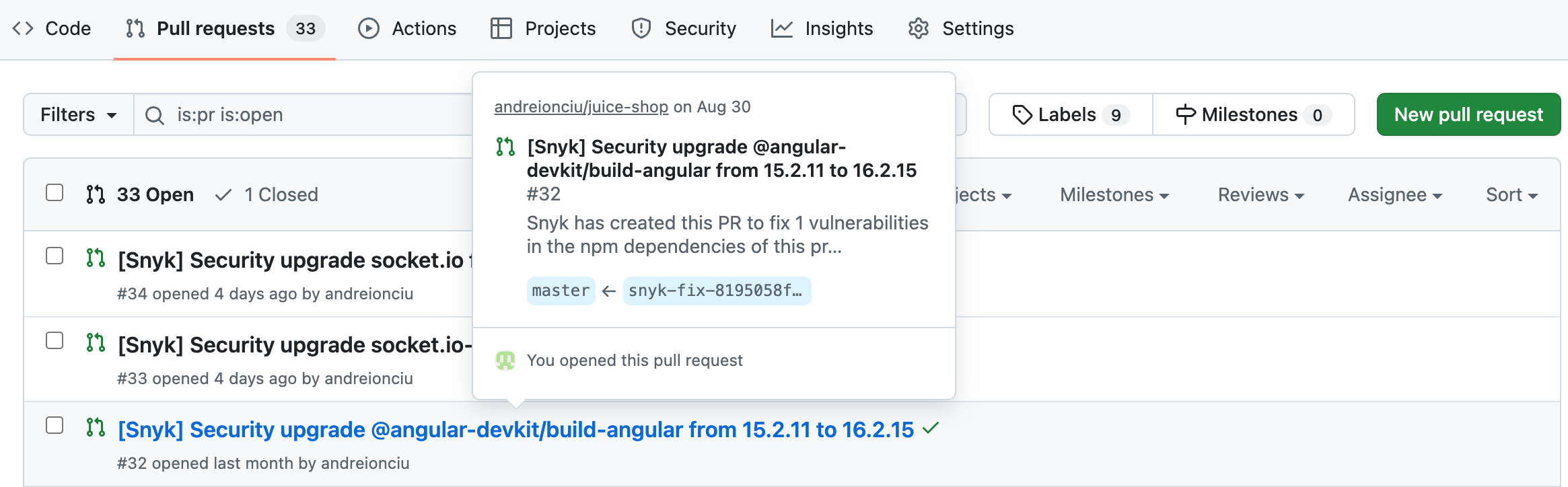
To quickly review the pull request, hover over it. You can see the recommended upgrade and other pull request summary details:
Recommended upgrade
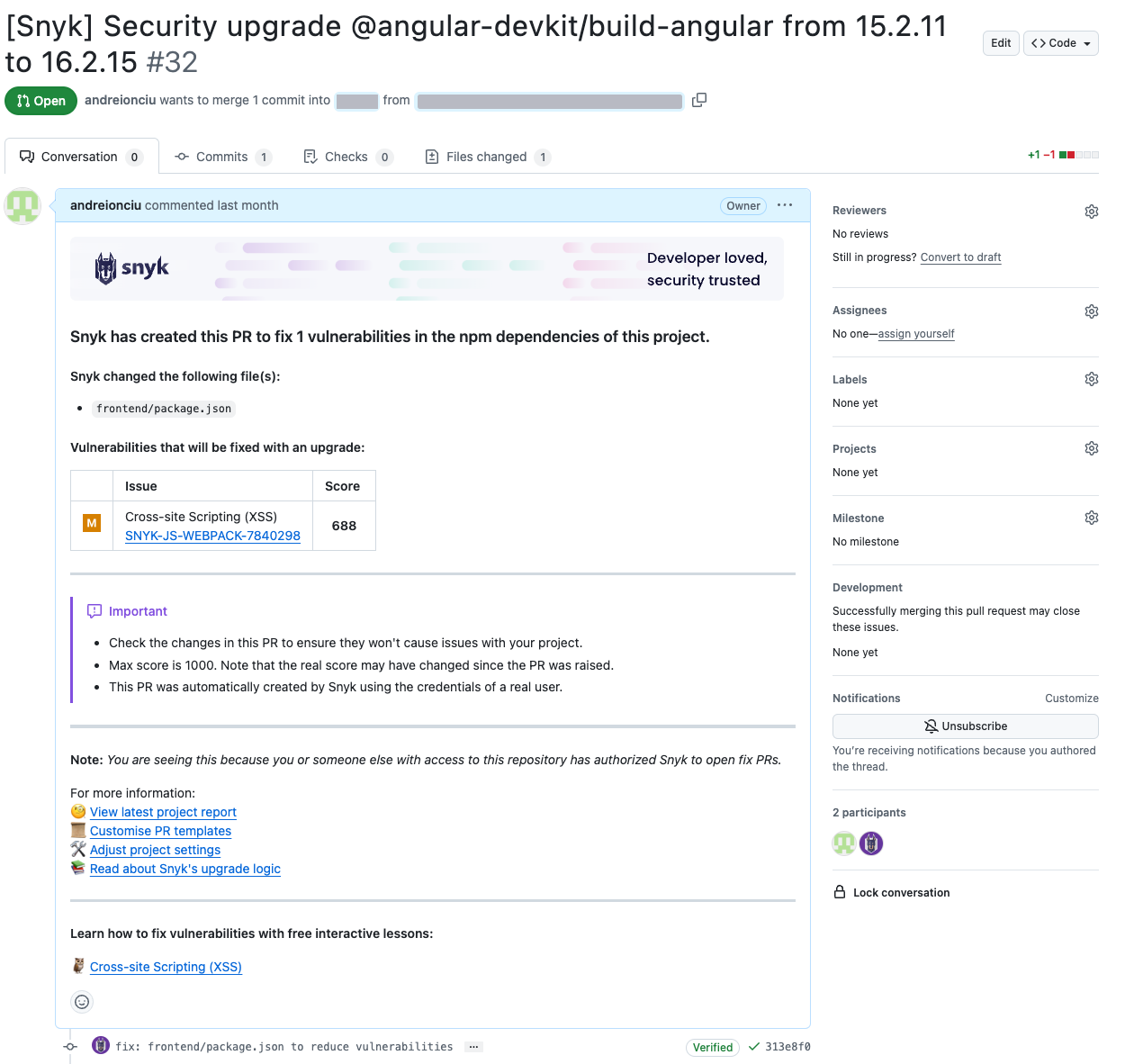
Open the pull request to view in-depth details, including package release notes and vulnerabilities included in the recommended upgrade. For package upgrade pull requests, Snyk includes a breakability risk level in the PR description and posts a follow-up comment with a more detailed analysis. For risk level definitions and guidance, see [Breakability risk levels](/scan-fix-and-prevent/fix/snyk-pull-or-merge-requests/breakability-risk-levels.md).
Pull request details
Click the Issue link from the table to view all details for the specified vulnerability directly from the Snyk database.
After you have reviewed the pull request, you can approve the merge.
### Generated Pull Requests report
Snyk provides a report for Enterprise customers that gives an overview of how [Fix](/scan-fix-and-prevent/fix/snyk-pull-or-merge-requests/enable-automatic-fix-prs.md), [Backlog](/scan-fix-and-prevent/fix/snyk-pull-or-merge-requests/enable-automatic-backlog-prs-for-previously-known-vulnerabilities.md), and [Upgrade PRs](/scan-fix-and-prevent/fix/snyk-pull-or-merge-requests/enable-automatic-upgrade-prs-for-new-dependency-upgrades.md) are used and highlights the efficiency of PR merges. For more information, see [Snyk Generated Pull Requests report](/scan-fix-and-prevent/prevent/analytics/reports-tab/prevention-reports.md#snyk-generated-pull-requests-report).
### Snyk SCM webhooks
To track pull request events, Snyk adds webhooks to your imported repositories. For more information, see the [GitHub and Git repository integrations](https://docs.snyk.io/developer-tools/integrations/scm-integrations/organization-level-integrations).
Snyk uses these webhooks to:
* Track the state of Snyk pull requests: when PRs are triggered, created, updated, merged, and so on.
* Send push events to trigger PR checks.
---
# Agent Instructions
This documentation is published with GitBook. GitBook is the documentation platform designed so that both humans and AI agents can read, navigate, and reason over technical content effectively. Learn more at gitbook.com.
## Querying This Documentation
If you need additional information that is not directly available in this page, you can query the documentation by asking a question.
Perform an HTTP GET request on the following URL with the `ask` and `goal` query parameters:
```
GET https://docs.snyk.io/scan-fix-and-prevent/fix/snyk-pull-or-merge-requests.md?ask=&goal=
```
`ask` is the immediate question: it should be specific, self-contained, and written in natural language.
`goal` is what the user is ultimately trying to achieve, the reason they need the answer. Sharing it helps GitBook give you a better, more relevant answer. A goal is most helpful when it describes the outcome the user wants rather than restating the question. For example, with `ask=how do I create an API token`, a goal like `automate deployments from our CI pipeline` lets GitBook tailor the answer to that use case.
The response will contain a direct answer to the question and relevant excerpts and sources from the documentation.
Use this mechanism when the answer is not explicitly present in the current page, you need clarification or additional context, or you want to retrieve related documentation sections.