> For the complete documentation index, see [llms.txt](https://docs.snyk.io/llms.txt). Markdown versions of documentation pages are available by appending `.md` to page URLs; this page is available as [Markdown](https://docs.snyk.io/scan-fix-and-prevent/prevent/pull-request-checks/configure-pull-request-checks.md).
# Configure Pull Request checks
How to configure Snyk Pull Request checks, including prerequisites, supported integrations, and the scans they run
{% hint style="info" %}
**Snyk is rolling out a new navigation.** The steps on this page describe the classic interface. If your view looks different, visit [Navigate the Snyk Web UI](https://docs.snyk.io/navigate-the-snyk-web-ui#where-things-moved) to map these options to the new interface.
{% endhint %}
## Configure Pull Request checks
{% hint style="info" %}
**Feature availability**
PR Checks for **Bitbucket Server** integrations require Bitbucket Server version 7.4 and above, or Bitbucket Data Center version 8 or above.\
\
When using a brokered connection Snyk Broker version 5.4.9 and above is required.
{% endhint %}
### Prerequisites for automated PR Checks
To check for open-source and licensing issues and code security, ensure that you have established the following:
* You have the Group Admin role so you have access to all integration settings. See [Member roles](https://docs.snyk.io/platform-administration/user-management/user-role-management).
* You have [set up a Git repository integration](https://docs.snyk.io/developer-tools/integrations/scm-integrations/organization-level-integrations). For help, see the Snyk Learn course [Source code manager configuration](https://learn.snyk.io/lesson/configure-snyk-scm/).
* Import a Project to have a working Git repository.
* For code security (Snyk Code), meet all of the above conditions and then contact your Snyk representative to enable the feature for you.
{% hint style="info" %}
PR Checks rely on webhooks from the SCM. Integration scope must include the ability to create webhooks.
A PR Check is counted as a test within your Organization's test count, including automatic checks of new commits in an open pull request. See[ What counts as a test](https://docs.snyk.io/snyk-data-and-governance/what-counts-as-a-test). The number of tests allowed is determined by the [pricing plans](https://docs.snyk.io/implementation-guides/enterprise-implementation-guide/trial-limitations).
{% endhint %}
### Types of Snyk scans supported
You can analyze the changed code with PR Checks as follows:
* **Snyk Code**: Source code changes result in a vulnerability that exceeds a specified threshold. A full scan of the repository is done to determine if there are new vulnerabilities.
* **Snyk Open Source**: Snyk analyzes dependency manifest or supported files for known security vulnerabilities that meet a threshold, such as exceeding severity, or checks to determine whether a fix is available.
* **Open Source license check**: Snyk validates package licenses against the configured policy for license policy violations.
PR Checks also support all programming languages and frameworks supported by the Snyk Code and Open Source engines. For more information, see [Supported languages, package managers, and frameworks](https://docs.snyk.io/supported-languages/supported-languages-package-managers-and-frameworks).
### How configuration of PR Checks works
You can configure PR Checks either [at the Integration level](#configure-pr-checks-at-the-integration-level) for your Snyk Organization or [for specific Snyk Projects](#configure-pr-checks-at-the-project-level) in an Organization.
* In your Organization, you can have multiple repository integrations, but the feature works only for those integrations that have PR Checks configured.
* At the Project level, the settings are inherited from the integration by default, but you can configure custom settings.
### Configure PR Checks at the integration level
Configure PR Checks for a specific Git repository you have already integrated with Snyk, such as a GitHub repository.
The configuration settings apply to all Projects in that Organization. You can also extend the configuration to Projects with custom settings.
1. In the Snyk Web UI, navigate to **Settings** > **Integrations** and select your connected source code manager to open the settings configuration.
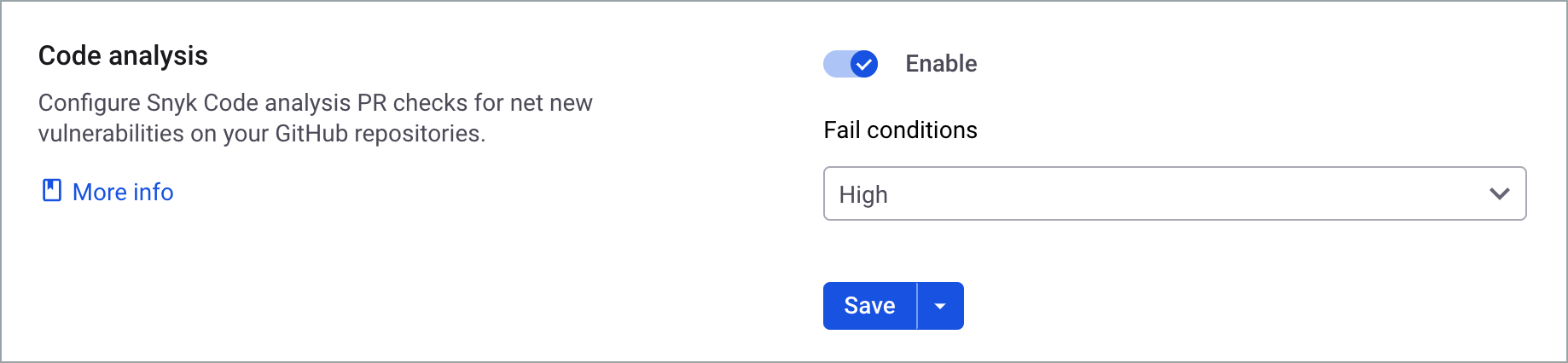
2. To check for code issues, configure and save the following changes:
* [ ] **Code Analysis**: Enable this option to fail the PR on new vulnerabilities detected in your Git repository. If the severity is higher than your threshold, the PR is not merged into the main branch.
* [ ] **Fail conditions**: Select the severity threshold at which the PR fails. For example, if you select **Medium**, the PR fails on issues found at this level or higher, while it is merged for **Low** severity issues.
PR Checks that are configured to “Only fail when the issues found have a fix available” rely on Snyk FixPR support and, therefore, will not alert for projects in languages that do not support FixPR Checks.
{% hint style="info" %}
A PR test is configured to be optional or blocking within your source control management platform, such as GitHub’s branch protection rules. To learn more on issue prevention, visit [Phase 6: Rolling out the prevention stage](https://docs.snyk.io/implementation-guides/enterprise-implementation-guide/automate-prevention-measures).
{% endhint %}
PR check settings to analyze code issues
{% hint style="info" %}
If you cannot see the **Code Analysis** section, ensure that your user has the Group Admin role assigned and that the feature is enabled for Snyk Code. See the [Prerequisites](#prerequisites).
{% endhint %}
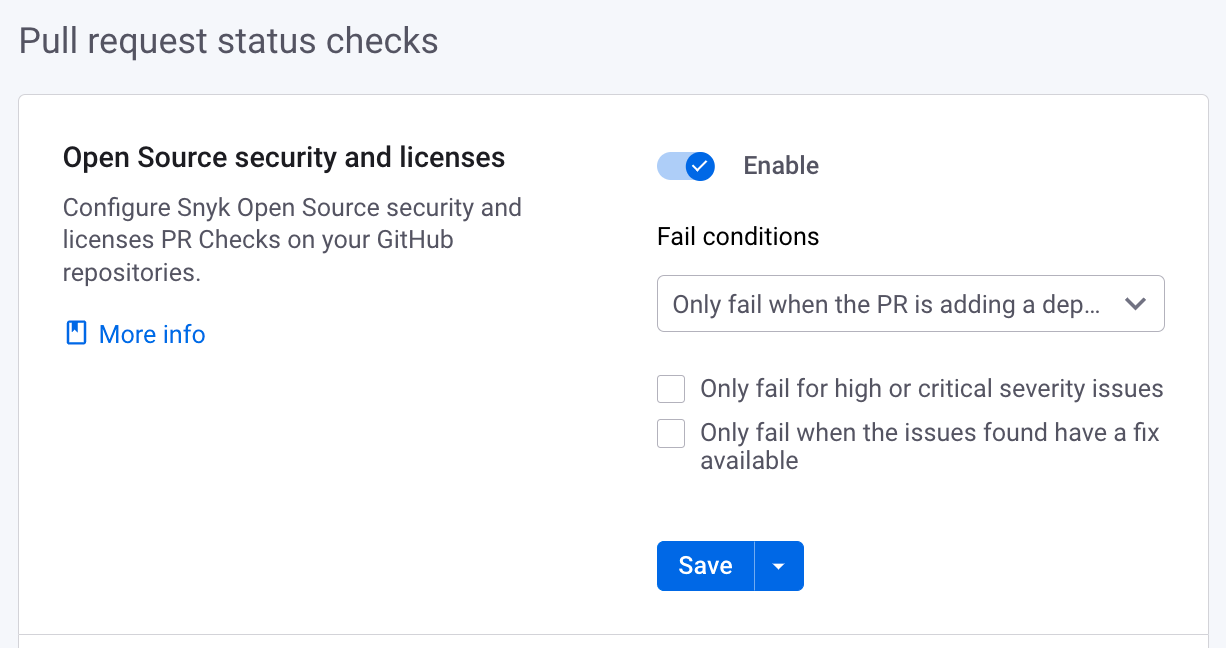
3. To check for open-source and licensing issues, configure and save the following changes:
* [ ] **Open Source Security & Licenses**: Enable this option to fail the PR when open-source and licensing issues found in the proposed changes exceed your specified severity threshold. If the severity is higher than your threshold, the PR is not merged into the main branch.
* [ ] **Fail conditions**: Select one of the following PR failure conditions based on the security issues distribution.
* [ ] **Only fail when the PR is adding a dependency with issues**: Set this condition to fail PR when there is at least one dependency with security issues.
* [ ] **Fail if the repo has any issues**: Set this condition to fail a PR for any security issues found in the Git repository.
* [ ] **Only fail for high or critical severity issues**: Select additional failure conditions based on the severity threshold.
* [ ] **Only fail when the issues found have a fix available**: Set this condition on for the PR check to fail when the PR introduces new vulnerabilities that are fixable by Snyk. PR checks don't fail on newly introduced vulnerabilities if Snyk is unable to fix them.
When switched on, this will cause the PR check to fail when the PR introduces new vulnerabilities that are fixable by Snyk. PR checks will not fail on newly introduced vulnerabilities if Snyk is unable to fix them.
PR check settings to analyze open-source and licensing issues
4. Either click **Save** to save the changes, select the Save dropdown and click **Apply changes to all overridden Projects** to extend the current configuration to Projects with custom settings. For more information, see [Configure PR Checks at the Project level](#configure-pr-checks-at-the-project-level).
### Configure PR checks at the Project level
You can configure PR checks to work only for specific Projects:
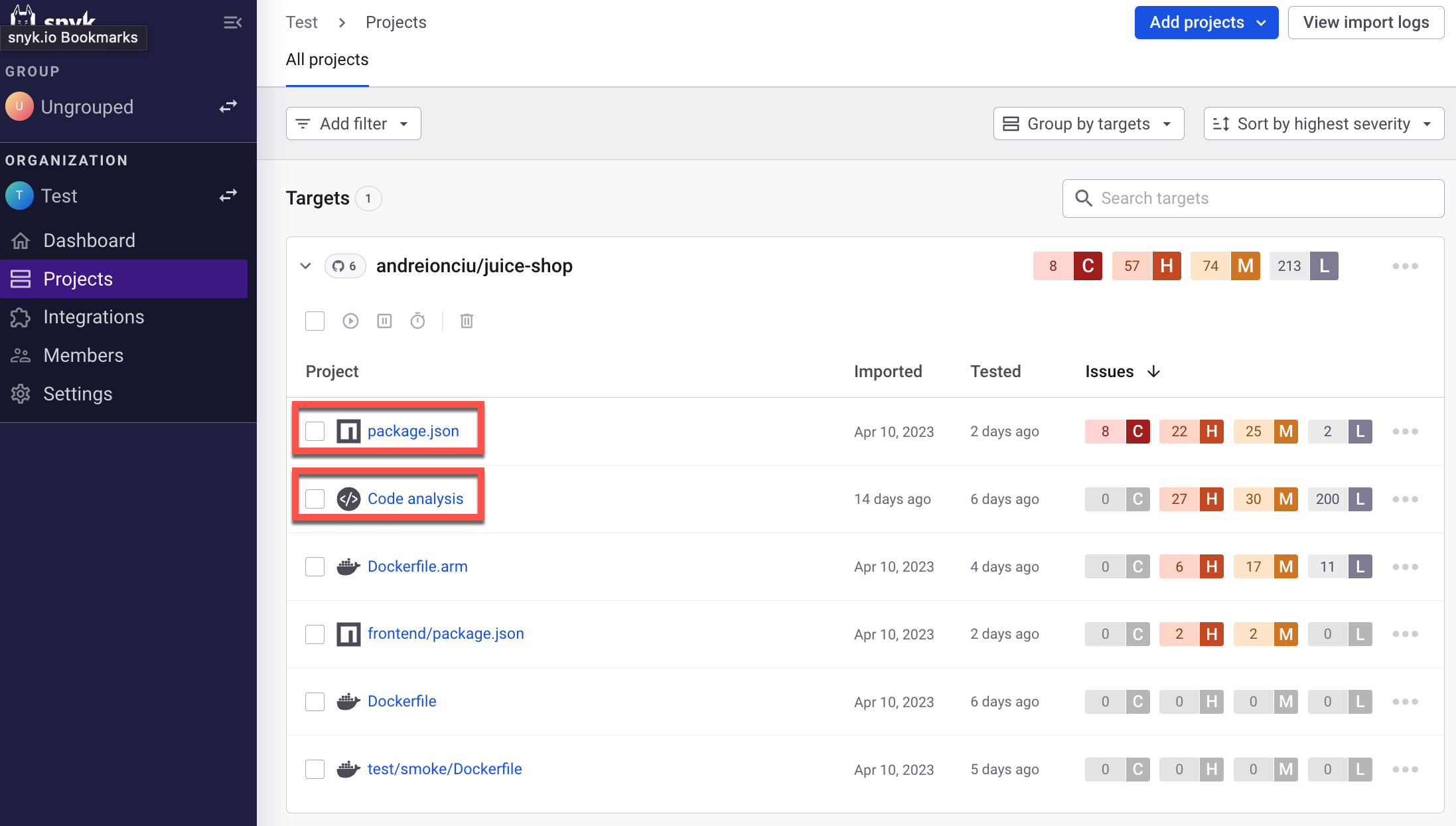
1. Navigate to **Projects** and expand the [target](/scan-fix-and-prevent/scan-with-snyk/snyk-projects.md#target) containing your Project.
2. Click a Project name to open it. Based on the Project type, you can choose the following:
* **package.json** to check for open-source and licensing issues.
* **Code analysis** to check for security issues in your code.
Project overview
6. Navigate to **Settings.**
7. On the left side, select your integration. For this example, GitHub has been integrated with Snyk.
8. Configure Project settings based on your Project type:
Configure for open source and licensing issues (click to expand)
1. In **Snyk test for pull request** select **Custom** to configure the settings.
2. Enable the option to fail the PR when open-source and licensing issues found in the proposed changes exceed your specified severity threshold.
3. Configure the following settings:
* [ ] **Fail conditions**: Select one of the following PR failure conditions based on the security issues distribution.
* [ ] **Only fail when the PR is adding a dependency with issues**: Set this condition when there is at least one dependency with security issues.
* [ ] **Fail if the repo has any issues**: Set this condition for any security issues found in the Git repository.
* [ ] **Only fail for high or critical severity issues**: Select additional failure conditions based on the severity threshold.
* [ ] **Only fail when the issues found have a fix available**: Set this condition on or more if the issues found have a dependency or package with a version in which the issue is fixed.
4. **Update Snyk pull request settings** to save changes.
Configure for code analysis (click to expand)
1. In **Snyk Code for pull request** select **Custom** to configure the settings.
2. Enable this option to fail the PR when the security issues found in the proposed changes exceed your specified severity threshold.
3. Configure the following settings:
* [ ] **Minimal severity to fail PR check**: Select the severity threshold at which the PR fails. For example, if you select **Medium**, the PR fails on issues found at this level or above, while it is merged for **Low** severity issues.
4. **Update Snyk pull request settings** to save changes.
---
# Agent Instructions
This documentation is published with GitBook. GitBook is the documentation platform designed so that both humans and AI agents can read, navigate, and reason over technical content effectively. Learn more at gitbook.com.
## Querying This Documentation
If you need additional information that is not directly available in this page, you can query the documentation by asking a question.
Perform an HTTP GET request on the following URL with the `ask` and `goal` query parameters:
```
GET https://docs.snyk.io/scan-fix-and-prevent/prevent/pull-request-checks/configure-pull-request-checks.md?ask=&goal=
```
`ask` is the immediate question: it should be specific, self-contained, and written in natural language.
`goal` is what the user is ultimately trying to achieve, the reason they need the answer. Sharing it helps GitBook give you a better, more relevant answer. A goal is most helpful when it describes the outcome the user wants rather than restating the question. For example, with `ask=how do I create an API token`, a goal like `automate deployments from our CI pipeline` lets GitBook tailor the answer to that use case.
The response will contain a direct answer to the question and relevant excerpts and sources from the documentation.
Use this mechanism when the answer is not explicitly present in the current page, you need clarification or additional context, or you want to retrieve related documentation sections.