> For the complete documentation index, see [llms.txt](https://docs.snyk.io/llms.txt). Markdown versions of documentation pages are available by appending `.md` to page URLs; this page is available as [Markdown](https://docs.snyk.io/scan-fix-and-prevent/scan-with-snyk/snyk-open-source/scan-open-source-libraries-and-licenses.md).
# Scan open-source libraries and licenses
How to scan open source libraries and licenses with Snyk Open Source
{% hint style="info" %}
**Snyk is rolling out a new navigation.** The steps on this page describe the classic interface. If your view looks different, visit [Navigate the Snyk Web UI](https://docs.snyk.io/navigate-the-snyk-web-ui#where-things-moved) to map these options to the new interface.
{% endhint %}
## Scan open-source libraries and licenses
You can scan your open-source libraries using Snyk Open Source:
* In the Snyk Web UI
* With your [IDE](https://docs.snyk.io/developer-tools/integrations/snyk-ide-plugins-and-extensions)
* With a [CI/CD integration](https://docs.snyk.io/developer-tools/integrations/snyk-ci-cd-integrations)
* Through the [Snyk CLI](https://docs.snyk.io/developer-tools/snyk-cli/scan-and-maintain-projects-using-the-cli/snyk-cli-for-open-source)
* Through the [Snyk API](https://docs.snyk.io/developer-tools/snyk-api/reference/test-v1)
### View vulnerabilities in your open-source libraries
You can view vulnerability results for imported Projects. The **Projects** page appears by default after import, showing vulnerability information for the Snyk Projects you have imported, grouped into **Targets**, that is, the repositories you have scanned.
You can expand a **Target** to see vulnerability information for Projects, including the number of issues found, grouped by severity level:
Click a Project to open the issues page for that Project, where, for supported environments, you can see the dependency cards, showing all of your dependencies, the versions where each associated issue was introduced, how to fix them, and more details about the individual vulnerabilities.
For unsupported environments, you can see a list of individual vulnerabilities. For more details, see [View Project information](/scan-fix-and-prevent/scan-with-snyk/snyk-projects/project-information.md).
### Fix vulnerabilities in your open-source libraries
For some languages, Snyk can fix vulnerabilities using fix pull/merge requests. For more information, see [Automatic and manual PRs with Snyk Open Source](/scan-fix-and-prevent/fix/snyk-pull-or-merge-requests.md).
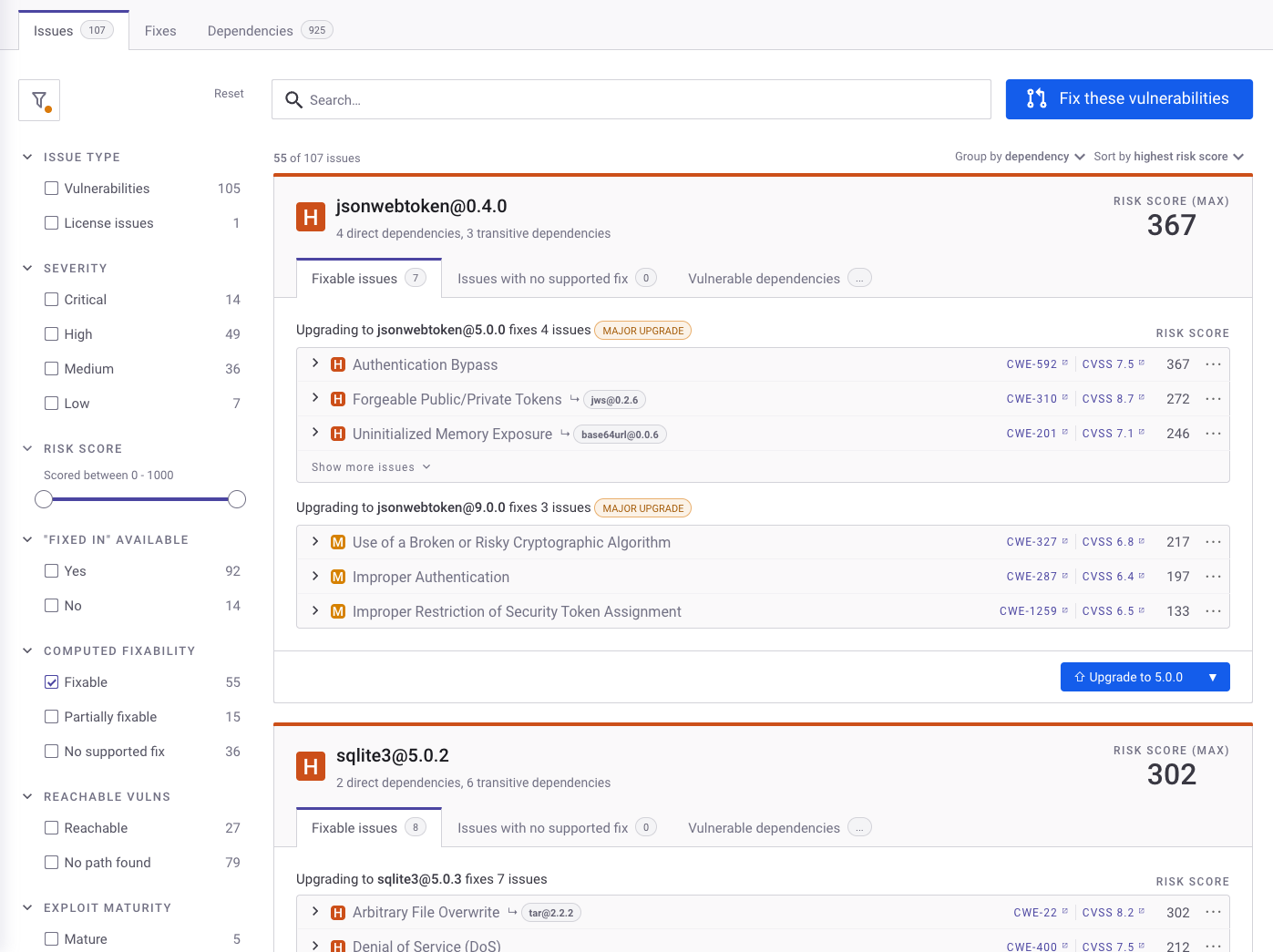
Navigate to the **Issues** card for a Project.
Issues tab in an Open Source Project
To fix vulnerabilities:
1. Click **Upgrade to X.X.X** to open a fix PR for this dependency. Click **Fix these vulnerabilities** at the top of the page to fix multiple issues.
2. The **Open a Fix PR** screen opens, displaying the selected vulnerabilities.
3. Check or uncheck the issues you want to fix or remove from this fix.
4. Scroll to the bottom of the screen and click **Open a Fix PR**.
5. Snyk acts on the PR and displays a results screen.
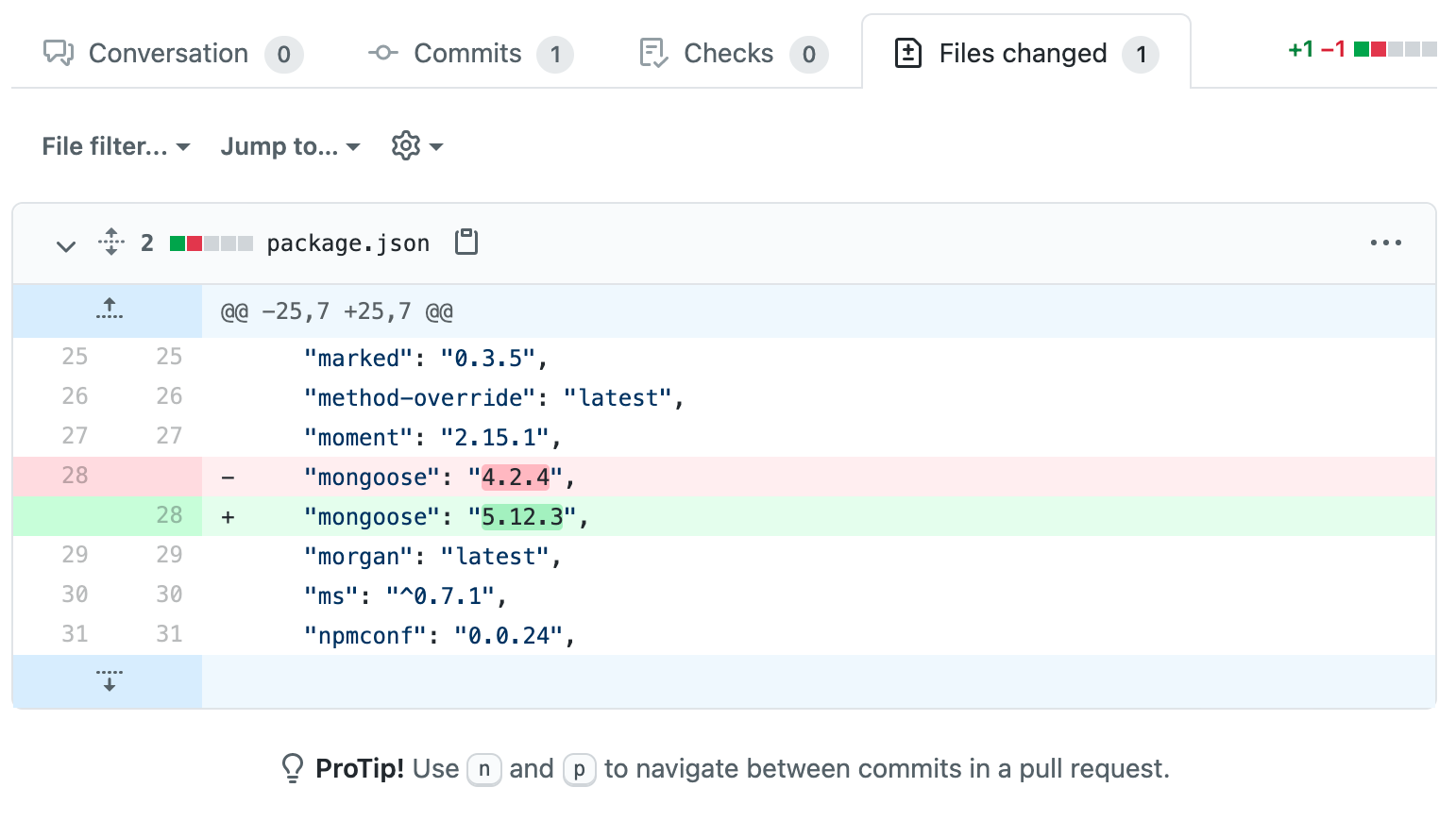
6. Optionally, select the **Files changed** tab to see details of the changes made.
Files changed tab in GitHub after triggering Fix PR for an open source project
For more details, see [Fix your vulnerabilities](/scan-fix-and-prevent/scan-with-snyk/snyk-open-source/manage-vulnerabilities/fix-your-vulnerabilities.md).
---
# Agent Instructions
This documentation is published with GitBook. GitBook is the documentation platform designed so that both humans and AI agents can read, navigate, and reason over technical content effectively. Learn more at gitbook.com.
## Querying This Documentation
If you need additional information that is not directly available in this page, you can query the documentation by asking a question.
Perform an HTTP GET request on the following URL with the `ask` and `goal` query parameters:
```
GET https://docs.snyk.io/scan-fix-and-prevent/scan-with-snyk/snyk-open-source/scan-open-source-libraries-and-licenses.md?ask=&goal=
```
`ask` is the immediate question: it should be specific, self-contained, and written in natural language.
`goal` is what the user is ultimately trying to achieve, the reason they need the answer. Sharing it helps GitBook give you a better, more relevant answer. A goal is most helpful when it describes the outcome the user wants rather than restating the question. For example, with `ask=how do I create an API token`, a goal like `automate deployments from our CI pipeline` lets GitBook tailor the answer to that use case.
The response will contain a direct answer to the question and relevant excerpts and sources from the documentation.
Use this mechanism when the answer is not explicitly present in the current page, you need clarification or additional context, or you want to retrieve related documentation sections.