> For the complete documentation index, see [llms.txt](https://docs.snyk.io/llms.txt). Markdown versions of documentation pages are available by appending `.md` to page URLs; this page is available as [Markdown](https://docs.snyk.io/platform-administration/snyk-hierarchy/organizations/manage-users-in-organizations.md).
# Manage users in Organizations
How to manage members of a Snyk Organization from the Members settings, based on your role permissions
{% hint style="info" %}
**Snyk is rolling out a new navigation.** The steps on this page describe the classic interface. If your view looks different, visit [Navigate the Snyk Web UI](https://docs.snyk.io/navigate-the-snyk-web-ui#where-things-moved) to map these options to the new interface.
{% endhint %}
## Manage users in Organizations
In the **Organization** where you want to manage users, select the **Members** menu option.
{% hint style="info" %}
You must have the permissions required to perform these tasks. For details, see [Pre-defined user roles](/platform-administration/user-management/pre-defined-roles.md) for a list of permissions.
{% endhint %}
### Add users
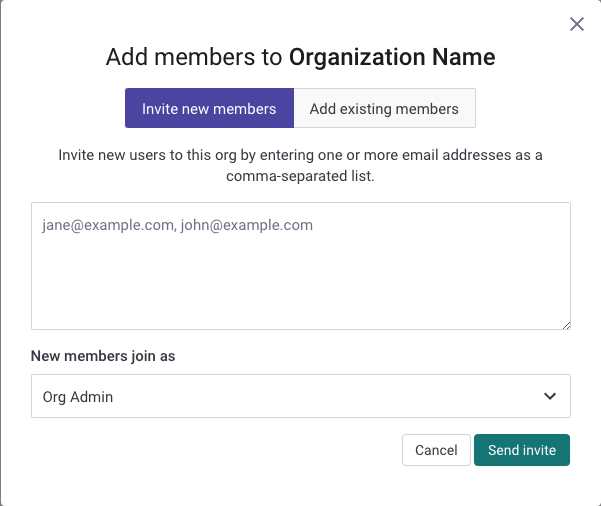
To add new users to your Organization, click **Add members**:
Add members to your Organization
You can do the following on the **Add members** screen:
* Select **Invite new members** to send an email invitation to a new user. Enter the email addresses of users to invite, separated by commas, and click **Send invite**.
* Select **Add existing members** to add existing members of your Group to the Organization. Select the users when prompted and click **Invite members.**
* For Free plan users only:\
Select **Invite by link** to send a link; click **Copy link** and send the link yourself. Note that an invite link expires after 48 hours.
* Use the **New members join as** dropdown to define the default role of a user when joining, such as **Org admin**. For details, see [Manage permissions](/platform-administration/user-management/pre-defined-roles.md).
For a demonstration of adding users, view this video:
{% embed url="" %}
Inviting members to an Organization
{% endembed %}
### Revoke pending invites
Follow these steps to cancel pending invites:
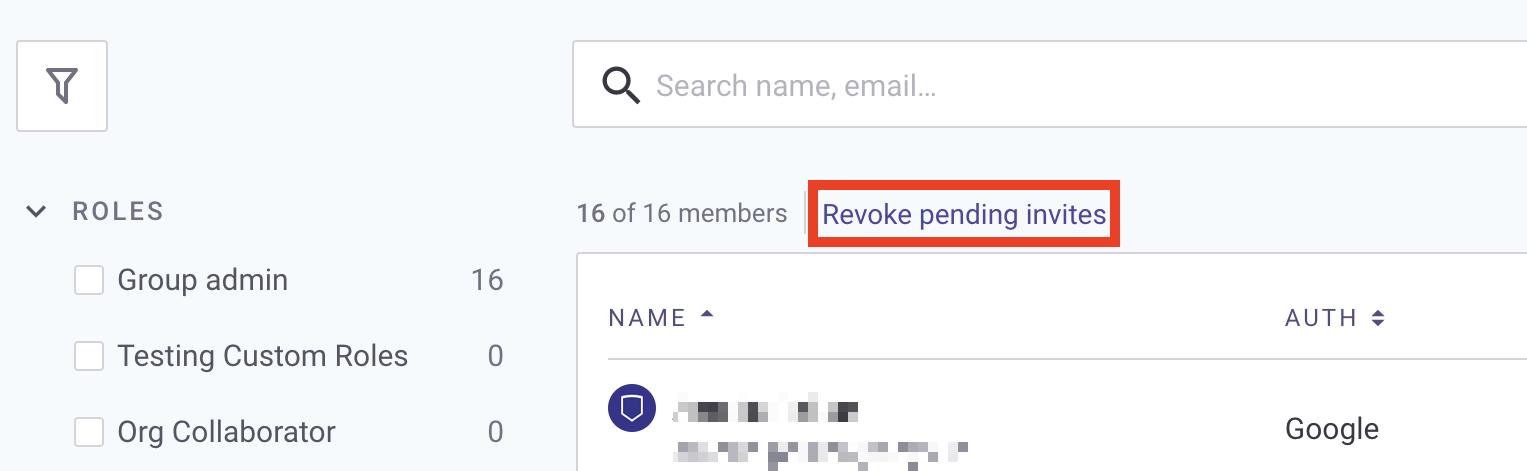
1. On the **Members** page, click the **Revoke pending invites link**, which appears when there is at least one pending invite.\\
Revoke pending invites
2. In the **Pending invites in \_your organization's name**\_ modal that appears, click the trash icon next to the name of the user to cancel the invite.
### Change member roles
To change the role of a user, click on the **Role** entry for the member and use the dropdown to select the new role:
Select new role
{% hint style="warning" %}
For Enterprise plan customers who create custom roles, Snyk prevents users from assigning roles to other users who have more privileges. If you try to update a role, invite a new user, or add an existing user with a role that has more privileges than you have, you will see the error **Cannot assign higher privilege role**.
{% endhint %}
### Delete Organization members
Follow these steps to delete a member from the Organization:
1. Click the trash icon next to the user.
2. Click **Delete member from** \[**your Organization’s name]** when prompted.
### Filter and sort views of Organization members
#### Filter views
Click the filter icon to expand the filter sidebar and then choose to filter the members displayed by role or authentication method:
Filter members by role or by authentication method
#### Sort views
Click on the column heading to sort user views:
Sort user views
You can sort by name, authentication method, role, and date joined.
---
# Agent Instructions
This documentation is published with GitBook. GitBook is the documentation platform designed so that both humans and AI agents can read, navigate, and reason over technical content effectively. Learn more at gitbook.com.
## Querying This Documentation
If you need additional information that is not directly available in this page, you can query the documentation by asking a question.
Perform an HTTP GET request on the following URL with the `ask` and `goal` query parameters:
```
GET https://docs.snyk.io/platform-administration/snyk-hierarchy/organizations/manage-users-in-organizations.md?ask=&goal=
```
`ask` is the immediate question: it should be specific, self-contained, and written in natural language.
`goal` is what the user is ultimately trying to achieve, the reason they need the answer. Sharing it helps GitBook give you a better, more relevant answer. A goal is most helpful when it describes the outcome the user wants rather than restating the question. For example, with `ask=how do I create an API token`, a goal like `automate deployments from our CI pipeline` lets GitBook tailor the answer to that use case.
The response will contain a direct answer to the question and relevant excerpts and sources from the documentation.
Use this mechanism when the answer is not explicitly present in the current page, you need clarification or additional context, or you want to retrieve related documentation sections.