> For the complete documentation index, see [llms.txt](https://docs.snyk.io/llms.txt). Markdown versions of documentation pages are available by appending `.md` to page URLs; this page is available as [Markdown](https://docs.snyk.io/developer-tools/snyk-api/using-specific-snyk-apis/webhooks-apis/guides-to-webhooks/how-to-use-snyk-webhooks-to-integrate-new-relic-with-snyk.md).
# How to use Snyk Webhooks to integrate New Relic with Snyk
How to integrate New Relic with Snyk using webhooks
{% hint style="info" %}
**Snyk is rolling out a new navigation.** The steps on this page describe the classic interface. If your view looks different, visit [Navigate the Snyk Web UI](https://docs.snyk.io/navigate-the-snyk-web-ui#where-things-moved) to map these options to the new interface.
{% endhint %}
## How to use Snyk Webhooks to integrate New Relic with Snyk
New Relic Security API is the most recent approach to having New Relic send any type of security-related information into the New Relic platform. This API is part of New Relic's Vulnerability Management capabilities.
Using New Relic Security API is beneficial because New Relic “understands” the type of data being ingested and is able to provide a curated user interface for the information. New Relic also offers a standardized way of correlating this information with other types of data that New Relic is able to consume. You can see the correlations on the tabs in New Relic, including the vulnerability management section of an entity.
Entity-level vulnerability management
Examples of such correlations are:
* For an application monitored by New Relic APM (Application Performance Monitoring), the Snyk Webhook provides the repository where the application resides. New Relic can then correlate issues Snyk identifies from an application security perspective with the APM data.
* For a container that is running inside a Kubernetes cluster where New Relic knows everything about the runtime behavior, the Snyk Webhook provides the ImageID. New Relic can then correlate detailed information provided about security aspects for the container.
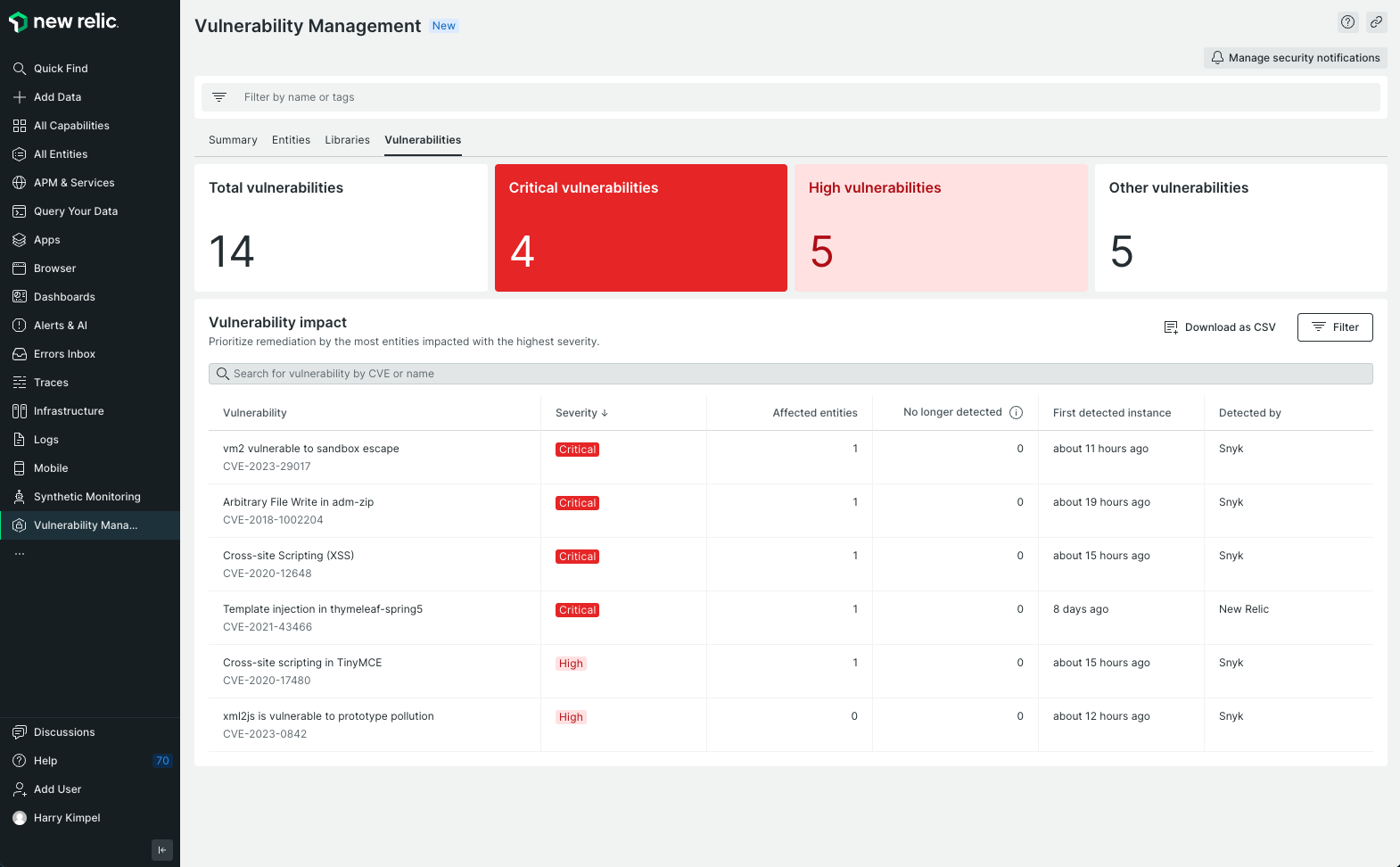
New Relic also provides a dedicated Vulnerability Management section for all of your security-related issues. The information shared using the Snyk webhook will automatically be populated automatically in this section.
Vulnerability Management
To set up the integration between Snyk and New Relic, follow the steps on these pages. There are two ways to achieve this:
1. Through New Relic's native security ingest processor: follow the guide on [New Relic docs](https://docs.newrelic.com/docs/vulnerability-management/integrations/snyk/) to get started
2. Through an Azure Function App that acts as a proxy: begin with [Create an Azure Function App](/developer-tools/snyk-api/using-specific-snyk-apis/webhooks-apis/guides-to-webhooks/how-to-use-snyk-webhooks-to-integrate-new-relic-with-snyk/create-an-azure-function-app.md).
If you have **problems** setting up or using the Snyk Webhook, **contact** your Solutions Engineer or Technical Success Manager for help.
---
# Agent Instructions
This documentation is published with GitBook. GitBook is the documentation platform designed so that both humans and AI agents can read, navigate, and reason over technical content effectively. Learn more at gitbook.com.
## Querying This Documentation
If you need additional information that is not directly available in this page, you can query the documentation by asking a question.
Perform an HTTP GET request on the following URL with the `ask` and `goal` query parameters:
```
GET https://docs.snyk.io/developer-tools/snyk-api/using-specific-snyk-apis/webhooks-apis/guides-to-webhooks/how-to-use-snyk-webhooks-to-integrate-new-relic-with-snyk.md?ask=&goal=
```
`ask` is the immediate question: it should be specific, self-contained, and written in natural language.
`goal` is what the user is ultimately trying to achieve, the reason they need the answer. Sharing it helps GitBook give you a better, more relevant answer. A goal is most helpful when it describes the outcome the user wants rather than restating the question. For example, with `ask=how do I create an API token`, a goal like `automate deployments from our CI pipeline` lets GitBook tailor the answer to that use case.
The response will contain a direct answer to the question and relevant excerpts and sources from the documentation.
Use this mechanism when the answer is not explicitly present in the current page, you need clarification or additional context, or you want to retrieve related documentation sections.